
Look, I get it. You’re busy closing deals, managing implementations, and putting out fires. Marketing? That’s been sitting on the back burner so long it’s probably welded to the stove by now.
You may have a website that hasn’t been touched since 2019. Maybe your “marketing strategy” is hoping your vendor throws you a bone with a few leads. Or you’ve got a sales team doing incredible work, but they’re basically winging it with zero support or direction, no case studies, no one-pagers, nothing to make their job easier.
If any of that sounds familiar, you’re not alone. Most ERP VARs I talk to are in the exact same spot. The good news? You don’t need a massive budget or a whole in-house marketing team to fix this. You just need a plan and 90 days.
Here’s how to build a marketing foundation that actually works.
Why 90 Days?
Three months is enough time to make real progress without overwhelming your already-packed schedule. It’s also enough time to see if what you’re doing is working, or if you need to adjust.
This isn’t about becoming a marketing guru overnight, or at all. It’s about putting the basic infrastructure in place so you can stop competing on price and start generating your own inbound leads. You know, the stuff that makes your sales team’s lives easier and your pipeline less dependent on vendor handouts.
Days 1-30: Get Your Foundation Sorted
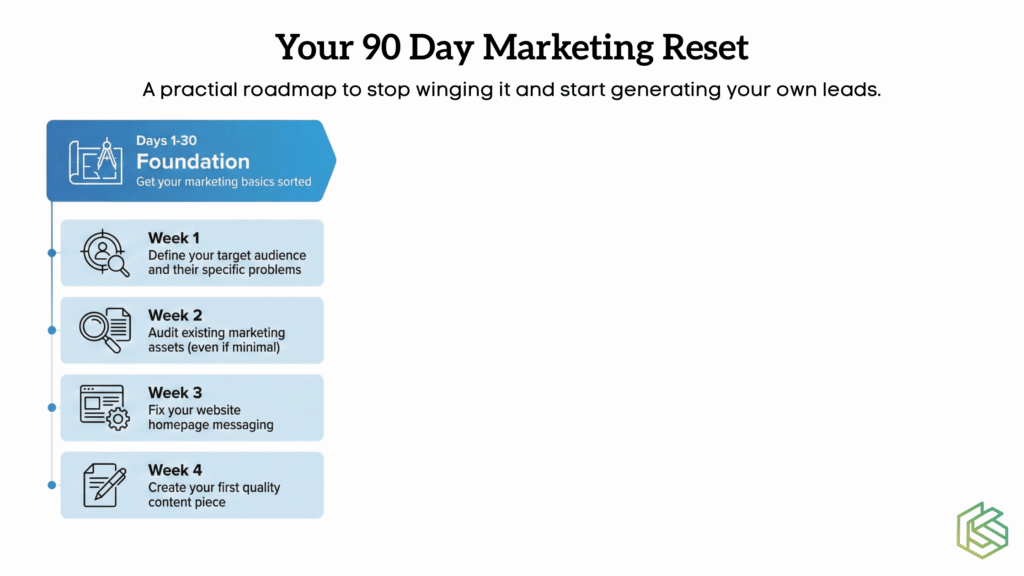
Week 1: Figure Out Who You’re Actually Talking To
You can’t market to “manufacturers” or “distributors” as a single, monolithic group. Get specific.
What to do:
- Pick 2-3 types of companies you do your best work with. Not just “manufacturers”—what kind? Food and beverage? Automotive? Job shops?
- Write down the problems they’re actually dealing with. Not “they need better software.” What’s keeping them up at night? Manual processes eating their margins? Inventory nightmares? Growth plans are stuck because their accounting system can’t handle it?
- Talk to your best customers. Ask them what they were struggling with before they found you. Use their exact words; this is gold for your messaging later.
Deliverable: A simple one-page document that says “We work best with [specific type of company] who are dealing with [specific problems].”
Week 2: Audit What You’ve Got (Even If It’s Basically Nothing)
Take stock of your current marketing assets. And yes, even if you think you have nothing, you probably have more than you think.
What to check:
- Website: Is it clear what you do and who you serve? Can someone figure out how to contact you in under 10 seconds?
- LinkedIn: Does your company page exist? What about your team’s profiles; do they make it clear what you do?
- Case studies or testimonials: Got any? Even informal ones?
- Sales materials: What’s your team using right now? Vendor decks? Nothing?
Deliverable: A brutally honest list of what’s working, what’s not, and what’s completely missing.
Week 3: Fix Your Website Homepage (Just the Homepage, for Now)
Your homepage has one job: make it instantly clear what you do, who you help, and why someone should care.
Quick fixes:
- Lead with the problem you solve, not with “We are a leading provider of…”
- Make it obvious who you serve. “ERP solutions for growing manufacturers” beats “enterprise software solutions” every time.
- Add a clear call-to-action. “Schedule a consultation” works. So does “Download our guide to [specific problem].”
- Update your copyright year. Seriously. If it says 2018, people notice.
You don’t need to redesign your whole site right now. Just make the homepage not suck.
Deliverable: A homepage that clearly communicates what you do and who it’s for.
Week 4: Create One Good Piece of Content
Stop overthinking this. You need one solid piece of content that helps your target customer with a real problem.
Ideas that work:
- “5 Signs Your [Industry] Business Has Outgrown [Software]”
- “What [Type of Company] Should Know Before Implementing [Your ERP Platform]”
- “The Real Cost of Manual Inventory Management for [Industry]”
Write it like you’d explain it to a prospect over coffee. No jargon, no fluff. Just useful information that positions you as someone who gets their world.
Deliverable: One blog post or downloadable guide (1,000-1,500 words) published on your website.
Days 31-60: Build Your Pipeline Engine
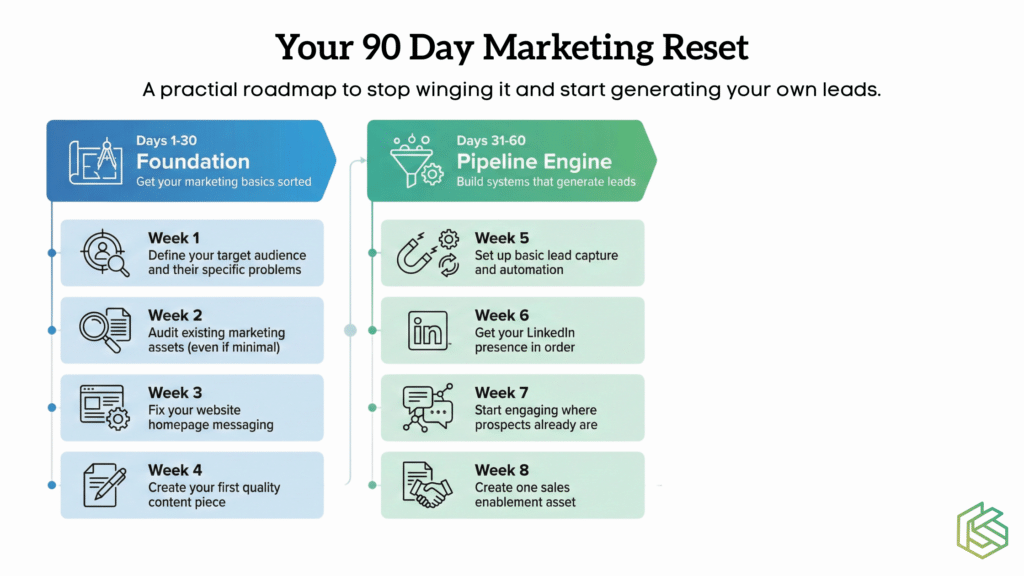
Week 5: Set Up Basic Lead Capture
Now that you’ve got something worth sharing, you need a way to capture interest.
What to do:
- Add a simple contact form to your website that actually works (test it yourself). If you do not already have one, do this early on.
- Create a PDF version of that content piece you wrote and gate it with a basic form. Name, email, company. That’s it.
- Set up an automated “thank you” email that delivers the content and tells them what to do next (like booking a call)
Tools like HubSpot’s free CRM or even just a Google Form can handle this. Don’t overcomplicate it.
Deliverable: A working lead capture system that doesn’t require you to manually email PDFs to people.
Week 6: Get Your LinkedIn House in Order
LinkedIn is where your buyers are researching solutions and checking you out. Make sure what they find doesn’t make them run.
Company page:
- Update your banner image to something that isn’t generic stock photos
- Write a company description that actually says what you do
- Post that content piece you created last month
Personal profiles (you + key team members):
- Headline should say what you do and who you help, not just your job title
- Add a summary that positions you as someone who understands your target customer’s world
- Make it easy to contact you
Deliverable: A LinkedIn presence that doesn’t look abandoned.
Week 7: Start Engaging (Not Just Broadcasting)
Here’s where most VARs get it wrong. They think LinkedIn is about posting their own content three times a week and calling it a day.
Actually working on LinkedIn means showing up where your prospects already are.
What to do:
- Spend 15 minutes, 3x per week, engaging with your target customers’ posts
- Not generic “great post!” comments. Actually, add something useful to the conversation.
- Share others’ content with your take on why it matters
- Join 2-3 groups where your target customers hang out and actually participate
This builds visibility and credibility without being pushy.
Deliverable: A LinkedIn engagement routine that takes less than an hour per week.
Week 8: Create One Sales Enablement Asset
Your sales team needs something they can actually use. Give them one solid tool this month.
Pick one:
- A one-page overview of your solution for a specific industry or use case
- A comparison guide (“When to Choose [Your ERP] Over [Common Alternative]”)
- A simple ROI calculator or cost-of-doing-nothing worksheet
- A case study that tells a before/after story (even if you have to anonymize it)
Make it something they can send after a discovery call or use in a presentation. Bonus points if it’s PDF-ready and actually looks professional.
Deliverable: One sales asset your team will actually use.
Days 61-90: Build Momentum
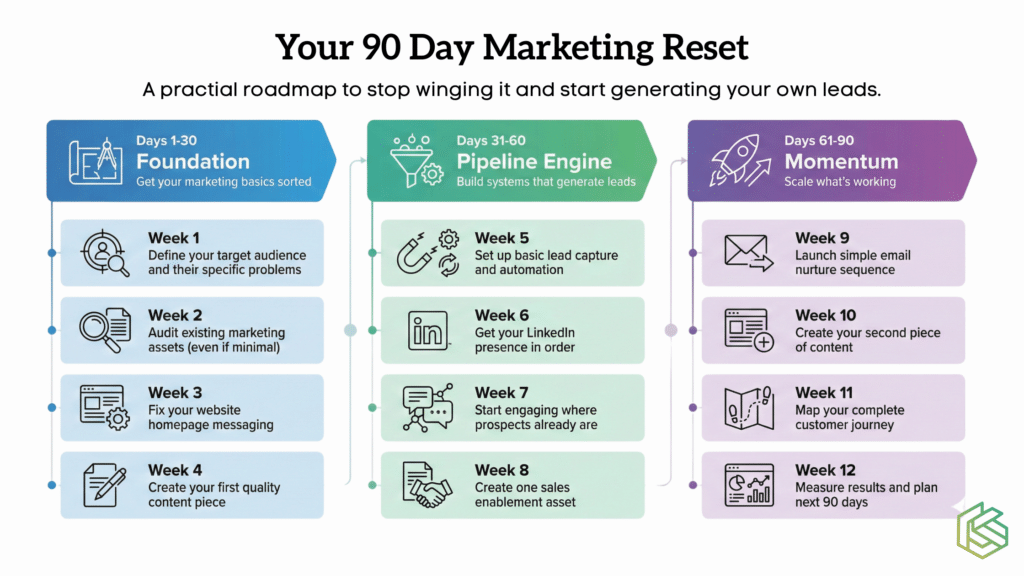
Week 9: Launch a Simple Nurture Sequence
Not everyone’s ready to buy right now. That’s fine. Stay on their radar without being annoying.
What to do:
- Set up a simple 3-email sequence for people who download your content piece
- Email 1 (immediate): Deliver the content, thank them, set expectations
- Email 2 (3-5 days later): Share a related resource or insight
- Email 3 (7-10 days later): Offer a next step (consultation, demo, another resource)
Keep it conversational. Write like you’re emailing a colleague, not blasting to a list.
Deliverable: An automated email sequence that keeps you top-of-mind.
Week 10: Create Your Second Piece of Content
Now that you know what’s resonating (check your website analytics and LinkedIn engagement), double down.
Ideas:
- Go deeper on a topic from your first piece
- Address the next logical question your prospects ask
- Turn a common sales conversation into a blog post or guide
Repurpose this content across LinkedIn, your email list, and anywhere else your prospects hang out.
Deliverable: A second piece of content published and promoted.
Week 11: Map Your Customer Journey
You need to understand the path someone takes from “never heard of you” to “let’s talk.”
What to map:
- Awareness: How do prospects first find you? (Web search, referral, LinkedIn, vendor events?)
- Consideration: What do they need to know before they take a meeting? (Proof you understand their world, case studies, pricing ballpark?)
- Decision: What’s the final push? (Demo, ROI conversation, reference calls?)
Identify gaps. Where are people falling off? What questions aren’t getting answered?
Deliverable: A simple customer journey map with gaps identified.
Week 12: Measure, Adjust, Plan
You’ve built the foundation. Now figure out what’s working and what needs tweaking.
What to track:
- Website traffic (even basic Google Analytics is fine)
- Lead form submissions
- LinkedIn engagement (profile views, post impressions, connection requests)
- Content downloads
- Sales conversations that started from marketing efforts
Don’t obsess over vanity metrics like total followers. Focus on whether you’re generating conversations with the right people.
Deliverable: A simple monthly report format you’ll actually use going forward.
What Happens After 90 Days?
If you’ve done this work, you’re no longer winging it. You’ve got:
- Clear positioning and messaging
- A website that doesn’t make you cringe
- Lead capture that works
- A basic content engine
- Sales enablement tools your team can use
- A LinkedIn presence that builds credibility
- A plan for what to measure and improve
The following 90 days? Keep building. More content. More engagement. More assets for your sales team. Start experimenting with things like email campaigns, webinars, or partnerships.
But here’s the thing, you don’t have to do this alone.
When to Call in Help
If you get to Day 30 and realize you’re drowning, or if you just don’t have the bandwidth to execute this while running your business, that’s exactly what a fractional CMO is for.
You get strategic marketing leadership without hiring a full-time employee. Someone who understands the ERP world, knows what actually works for VARs, and can hit the ground running while you focus on what you do best, closing deals and delivering for clients.
What is the difference between DIY and bringing in a fractional CMO? Speed and expertise. What takes you 90 days to figure out through trial and error, someone who’s done it a dozen times can execute in half the time with better results.
The Bottom Line
Most ERP VARs have incredible expertise and strong customer relationships, but they’re invisible to the market because they’ve never invested in marketing. Meanwhile, their competitors, who might not even be better, are scooping up the leads because they showed up consistently with the right message.
Ninety days won’t turn you into a marketing powerhouse overnight. But it will get you from “winging it” to “actually having a plan.” And that’s enough to start generating your own pipeline instead of waiting for vendor scraps.
Ready to stop winging it? Pick a start date and get moving. Or if you’d rather have someone who’s done this before take it off your plate, let’s talk.
About Esper Strategies
I’m Hayley, founder of Esper Strategies. I provide fractional CMO services for ERP VARs and implementation partners—strategic marketing leadership without the overhead of a full-time hire. After 10+ years working with Canadian and American VARs, I know what works (and what’s a waste of time) in this space. If you’re tired of competing on price and ready to build a marketing engine that actually supports your sales team, let’s talk. Book a call