
Growth, diagnosed
Before you spend more on growth, find out what needs to change.
For B2B technology and service companies that have outgrown referrals but haven't built what replaces them.
You're considering a sales hire, another campaign, a new market or a website rebuild. But you're not sure it will solve the problem.
The Growth Diagnostic is a focused investigation into what's getting in the way of growth, why it's happening and what deserves attention first.
Core Diagnostic
$4,000 CAD
· Two to three weeks
My deepest experience is in ERP and B2B technology, where a full pipeline can hide stalled buying decisions, referrals can carry a business until they don't, and a strong reputation doesn't always explain why the next buyer should choose you.
We'll spend 20 minutes on what's happening and what you're trying to decide. If the Diagnostic isn't the right starting point, I'll tell you.
When the next move isn't clear
The Diagnostic is built for when something has changed, and the usual response isn't working.
Referrals or partner leads have slowed, and you need to decide where to invest next.
You've increased marketing activity or hired a salesperson, but the results haven't moved enough.
Good opportunities keep stalling, and "the buyer went quiet" isn't giving you much to work with.
You're entering a new market, launching a new offer or chasing a different type of buyer, but interest isn't turning into business.
You know something needs to change. The harder question is what's causing the problem and which decision comes first.
What we examine
We look across four areas of growth, then concentrate on the evidence most relevant to your situation.
Positioning
Who chooses you, why they choose you and whether other good-fit buyers can see the same reason.
Pipeline
Where good opportunities come from, which ones fit and what happens when your usual sources slow down.
Sales
Where deals stall, who is involved in the buying decision and what buyers still need before they can move.
Customer Growth
How existing customers renew, expand and refer, and whether anyone is actively managing those opportunities.
This is one focused investigation, not four separate audits.
How the Growth Diagnostic works
01
Define the question
We start together. What changed? What have you already tried? What are you trying to decide?
We agree on the question we're investigating, who needs to be involved and what I need to see.
02
Get close to the problem
I talk with the people closest to what's happening and review a focused sample of the evidence: recent opportunities, lost deals, customer accounts, proposals, sales materials, website messaging, marketing activity or lead sources, depending on the problem.
When it helps, I'll spend time on-site with your team. Hearing how different people describe the same problem, and watching how work moves between teams, surfaces things a scheduled video call won't.
03
Find the pattern
I step back from the individual explanations and look across everything I've heard and seen.
Where does the evidence agree? Where does it conflict? What keeps happening? What are we assuming without enough evidence?
If the evidence doesn't support a conclusion, I'll say so.
04
Decide what comes first
I bring the findings back to leadership and we work through them together. We challenge the conclusions, weigh the trade-offs and decide what deserves attention first.
What you leave with
The point isn't a longer marketing wish list. It's enough clarity to decide where your team's time, attention and money go next.
Growth Diagnostic report
01
A written Growth Diagnostic report: what I found, what the evidence supports and what we're still assuming.
02
The most important constraints and opportunities, ranked by priority, with the reasoning behind each.
03
A recommended sequence of actions and decisions, including what happens first and what can wait.
04
Measures to watch, so you can tell whether the changes are improving the problem.
05
Information gaps worth investigating, where the evidence isn't strong enough to draw a conclusion yet.
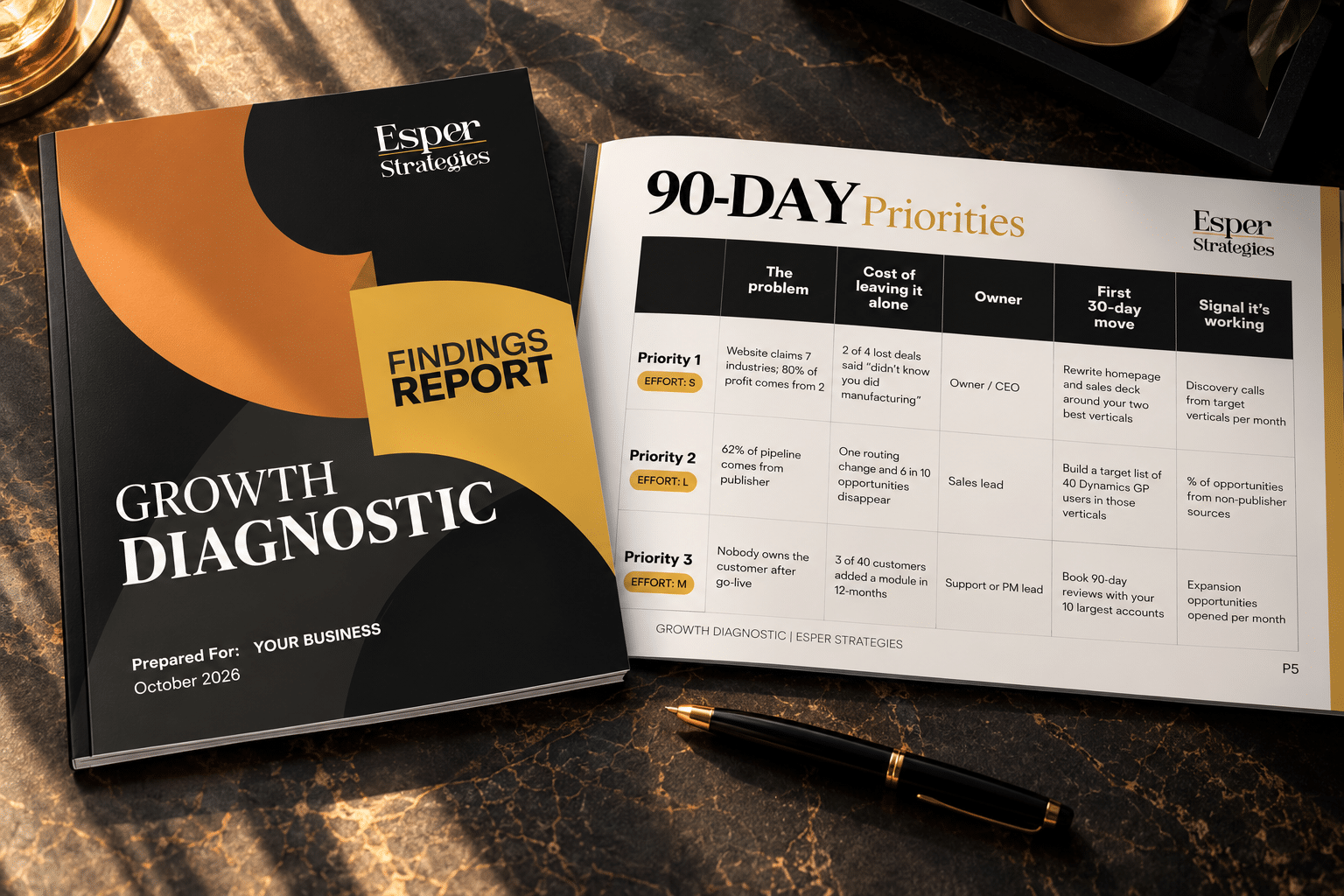
Sample pages. Details are illustrative.
What I need from you
The Diagnostic only works if I can get close to the problem. That means access to the people involved, the relevant information, and a senior leader who can give context, answer questions and join the final discussion.
Everything you share is confidential. We'll agree on any additional confidentiality requirements before we start.
The Diagnostic is built for companies with a real growth problem, enough information to investigate it, and leadership ready to act on what we find.
If you already know what's wrong and what needs to happen next, you don't need a Diagnostic. A focused project is the better fit.
Scope and fee
Core Growth Diagnostic:
$4,000 CAD
Includes the agreed evidence review, interviews, analysis, written report and leadership readout. Most Diagnostics are completed within two to three weeks once I have access to the people and information we agreed on.
The fee covers the investigation and recommendations. Implementation is separate. If you want Esper's help carrying out what we find, we'll scope that after the Diagnostic.
On-site investigation
For companies in the Greater Toronto Area, one on-site working day is included. Outside the GTA, we quote travel expenses separately and agree them in writing before the engagement starts. There's no additional fee simply because the work is on-site.
What it's like to work with me
"When I stepped into the role to run GtM for our ERP organization, our content strategy was all over the place. Working with Hayley helped to stay focused on developing content that mattered to our target audience(s) and would perform in SEO and AEO."
Anna Crean, VP of Growth (ERP), i-Tech Support
What happens after the Diagnostic?
Your team might have everything it needs to move forward. The findings might point to a focused project, or to Fractional Growth Leadership if the problem needs continuing senior attention.
The next engagement should follow the problem. Not the other way around.
Tell me what you're trying to figure out.
Tell me what's happening, what you've already tried and what you're trying to decide.
We'll spend 20 minutes talking it through. If the Diagnostic makes sense, I'll explain why. If it doesn't, I'll tell you that too.